Cloudflare, Vercel and Netlify all put a free tier in front of you and all claim to scale with your app. Then the invoice arrives and the three bills look nothing alike, because each company converts usage into money by a different rule. Cloudflare sells a flat $5 Workers plan and refuses to charge for bandwidth. Vercel charges per developer seat and bundles a slice of CDN capacity. Netlify sells credits, and every gigabyte, deploy and function second eats into the same pool.
So I did what I do with any quote: I wrote the same three workloads into a spreadsheet and priced them on all three platforms, using only the list prices each vendor publishes and reading every one of them on 24 November 2026. Same requests, same bandwidth, same team. The spread was large enough that I would not trust a “best hosting” listicle again.

Quick comparison: what you actually pay for
| Cloudflare (Workers Paid + Pages) | Vercel Pro | Netlify Pro | |
|---|---|---|---|
| Base price | $5/month minimum per account | $20 per developer seat/month, plus a $20 monthly usage credit | $20/month with unlimited members |
| Requests included | 10M/month, then $0.30 per million | Flat Rate CDN tier: 1M/month; the next tier is 10M | Bought with credits: 2 credits per 10,000 requests |
| Bandwidth included | No egress charges at all | 1TB in the included CDN tier | Bought with credits: 20 credits per GB |
| Compute | 30M CPU-milliseconds included, then $0.02 per million | Invocations $0.60/M, active CPU $0.128/hour, memory $0.0106/GB-hour | 10 credits per GB-hour |
| Deploys and builds | 500 builds/month on the free plan, 5,000 on Cloudflare’s Pro plan; no per-deploy fee | Build minutes $0.007/min on basic machines | 15 credits per production deploy |
| What the bill punishes | Dynamic CPU time and build volume | Developer headcount and traffic above 1M requests / 1TB | Anything heavy: bandwidth first, then deploys |
| Free tier headline | 100,000 requests/day, 10ms CPU per invocation, static assets free and unlimited | 1M CDN requests, 100GB transfer, 4 CPU-hours, 1M invocations | 300 credits/month, hard limit, then the site pauses |
Read that table again and notice what is missing: Netlify does not sell you requests or bandwidth at a unit price at all. It sells you a credit balance and a conversion table, which is a different product category wearing the same label.
Cloudflare: the $5 that does not move
Cloudflare’s Workers Paid plan is a $5 monthly minimum per account. Inside it you get 10 million requests and 30 million CPU-milliseconds a month. Beyond that, requests cost $0.30 per million and CPU costs $0.02 per million milliseconds. Static asset requests are free and unlimited on both the free and paid Pages plans, and Cloudflare states plainly that there are no additional charges for data transfer or bandwidth.
That last sentence is doing a lot of work. A 2TB month costs the same $5 as a 2GB month. In my spreadsheet, every scenario that stayed under 10 million requests and inside the CPU allowance landed at $5, whatever the bandwidth.
The catch is not the price, it is the shape of the platform. You are not buying a Node server that can do anything; you are buying V8 isolates behind a strict runtime, and a framework needs an adapter to run there. Cloudflare also splits the job in two: Pages for the static build, Workers for the dynamic part, with Pages Functions billed as Workers requests.
My favourite detail in their own documentation is the worked example: 15 million requests at 7ms of CPU each comes to $8 USD a month — $5 subscription, $1.50 of requests, $1.50 of CPU. Very few vendors publish a bill that small for that volume, and none of the other two can match it.
Vercel: you are paying for seats, then capacity
Vercel’s Pro plan is $20 per developer seat per month, and the pricing table lists one developer seat with each $20. Viewer seats are free, so stakeholders can look without a licence. On top of the seat price the plan carries $20 of monthly usage credit and one Flat Rate CDN tier: 1 million CDN requests and 1TB of data transfer.
Flat Rate CDN is the part most comparisons miss. Capacity is sold in steps, not per gigabyte: 1M requests and 1TB included, then $20/month for 10M requests and 50TB, $100/month for 50M requests, $300/month for 150M. A traffic spike does not change your bill mid-month; you get moved up a tier at the start of the next cycle. That is a genuinely pleasant way to buy hosting if you have been burned by a surprise overage.
The per-unit rates still exist for everything outside the tier and for teams that outgrow it: starting at $2 per million CDN requests and $0.15 per GB of fast data transfer — Vercel prices those two by region — plus $0.60 per million function invocations, $0.128 per active CPU hour and $0.0106 per GB-hour of provisioned memory. Spend management is on by default, with alerts before on-demand charges start.
Three developers is therefore $60 a month before any overage, and that is the number to compare against a $5 Cloudflare bill. What you are buying for the difference is the build system and the framework integration, not bandwidth. If Next.js is the whole stack and nobody wants to maintain an adapter, that $55 is usually money well spent. If it is a static site with a few API routes, it is hard to justify.
Netlify: one credit pool, and a very sharp exchange rate
Netlify replaced its old usage buckets with credits for all new accounts since September 2025. Free gets 300 credits a month as a hard limit. Personal is $9 for 1,000 credits and one member. Pro is $20 for 3,000 credits with unlimited members, and you can choose a larger monthly tier up to 20,000 credits.
The conversion table is where the money is: 20 credits per GB of bandwidth, 2 credits per 10,000 requests, 15 credits per production deploy, 10 credits per GB-hour of compute. At the published Pro top-up rate of $10 for 1,500 credits, one gigabyte of bandwidth is about 13 cents, a million requests about $1.33, and a production deploy about 10 cents.
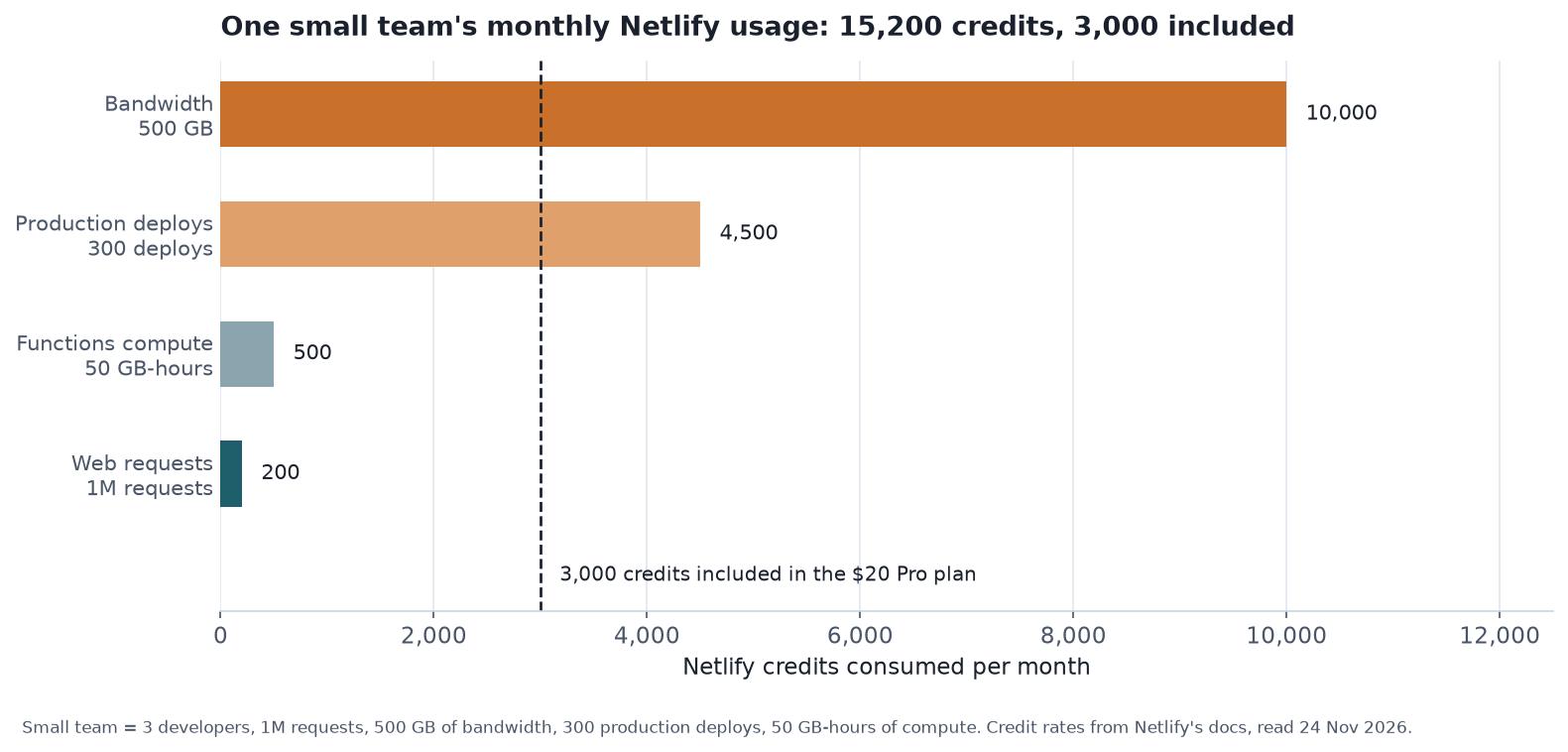
Put a normal small team into that pool and the 3,000 credits vanish before bandwidth is even finished. 500GB of traffic is 10,000 credits on its own. Add 300 production deploys (4,500 credits) and 50 GB-hours of functions (500 credits) and the month needs 15,200 credits — five times the included allowance, or about $90 of credit packs on top of the $20 plan.
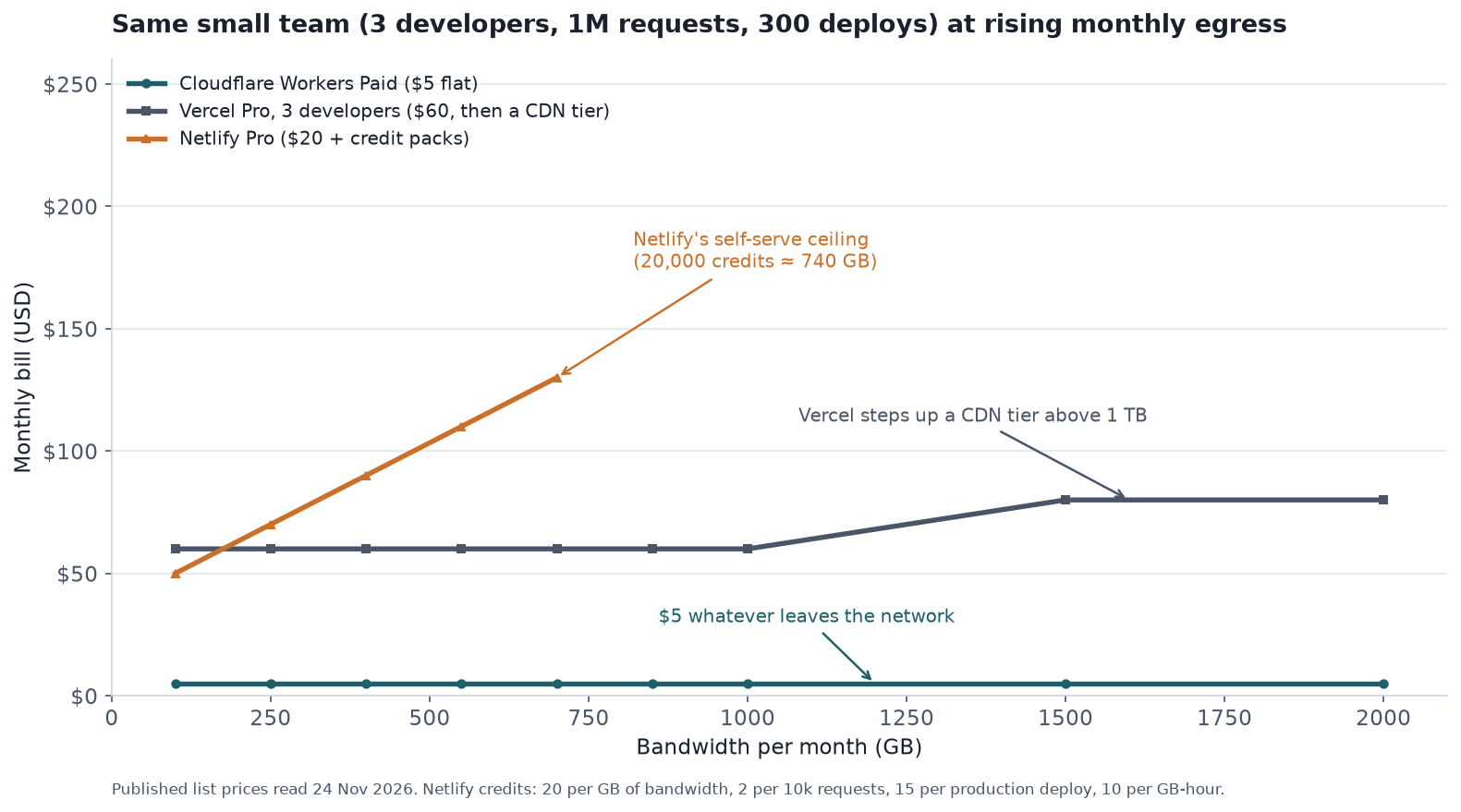
Two things soften this. Preview and branch deploys are free, as are failed deploys and rollbacks. And the higher Pro tiers (from 5,000 credits up) roll unused credits into the next month, which the base tier does not. But the ceiling matters: 20,000 credits is 1TB of bandwidth before deploys and compute are paid for. A site that outgrows that is not on a bigger Pro plan, it is talking to sales.
What Netlify does give you for the $20 is the thing Vercel charges per seat for: unlimited members, shared environment variables, private organisation repositories and 30-day analytics. If your team is four people and your traffic is modest, the credit model can be the cheapest of the three. If your traffic is not modest, it is the most expensive by a wide margin.
The same three bills, on the same workloads
These are the scenarios I priced. Each one assumes 20% of requests hit a function at roughly 10ms of CPU, and that a deploy is a two-minute build. Everything else is the vendors’ published rates.
| Workload | Cloudflare | Vercel | Netlify |
|---|---|---|---|
| Solo starter 1 developer, 200k requests, 50GB, 100 deploys, 5 GB-hours | $5 one Workers subscription | $20 one seat, usage inside the $20 credit | $20 (2,590 credits) Pro is cheaper than Personal plus packs |
| Small team 3 developers, 1M requests, 500GB, 300 deploys, 50 GB-hours | $5 still inside 10M requests and 30M CPU-ms | $60 three seats, traffic inside the included CDN tier | $110 (15,200 credits) $20 plan plus about $90 of credit packs |
| Content site 2 developers, 5M requests, 2TB, 60 deploys, 10 GB-hours | $5 egress is not billed | $60 two seats plus the $20 CDN tier above 1TB | Enterprise quote 42,960 credits is past the 20,000-credit Pro cap |
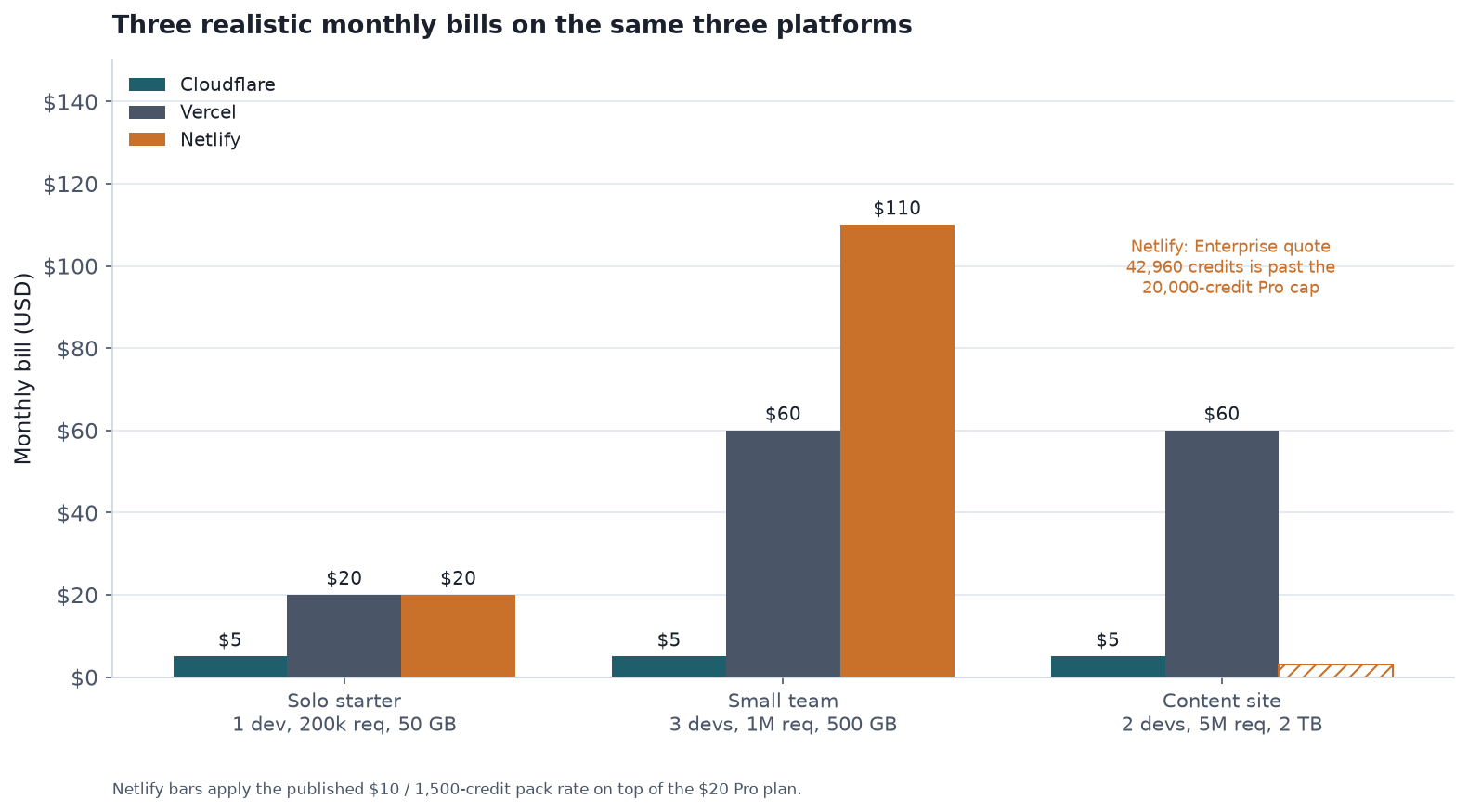
The pattern is not “Cloudflare cheap, everyone else expensive”. It is that Cloudflare’s bill ignores traffic, Vercel’s bill tracks people, and Netlify’s bill tracks volume through a single exchange rate. A five-person team with a light site is the one case where Vercel is the pricey option; a media-heavy site is the one case where Netlify’s self-serve plans stop being an option at all.
Unit rates, once the included allowances are gone
| What you are buying | Cloudflare | Vercel | Netlify |
|---|---|---|---|
| 1 million extra requests | $0.30 | $2.00 on-demand, or the next CDN tier | $1.33 |
| 1TB of bandwidth | $0 | $150 on-demand; 1TB is included in the tier | $133 (20 credits per GB) |
| 1,000 production deploys (2-minute builds) | $0, but counts against the build allowance | about $14 of build minutes | $100 |
| 100 CPU-hours of functions | $6.60 beyond the 30M CPU-ms included | $12.80 of active CPU, plus memory | billed per GB-hour instead: $6.67 per 100 GB-hours |
Those numbers explain the surprises. Ten thousand deploys a month is normal for a team merging all day, and on Netlify that habit alone is $1,000. On Vercel it is about $140 of build minutes. Nobody puts “deploy frequency” in a hosting comparison table, and yet for a busy team it can be the largest line item after bandwidth.
How to choose
1. Static site, brochure or blog, one to three people. Cloudflare Pages, free plan, until you need functions. Then Workers Paid at $5. If you deploy more than 500 times a month, Cloudflare’s Pro plan raises the build allowance to 5,000. This is the cheapest competent answer in 2026 and it is not close.
2. Next.js product with a small team. Vercel Pro. Three developers is $60, traffic sits inside the included CDN tier for a long time, and you never debug an adapter at 1am. Budget for $80 once you pass 1TB, not for a surprise: the tier steps are published.
3. Media or download-heavy site. Cloudflare, for the simple reason that egress is free. Two terabytes a month on Cloudflare is $5; on Netlify’s credit system it is past the self-serve ceiling; on Vercel it is $80 but only because the next tier carries 50TB, which is good value once you are there.
4. Small team that wants one dashboard and unlimited seats. Netlify Pro at $20 is a fair deal under about 150GB of bandwidth plus modest deploys. Model your own month in credits before you commit, because the included 3,000 credits are consumed faster than the marketing suggests.
Key takeaways
- Cloudflare Workers Paid starts at $5/month with 10M requests, 30M CPU-ms included and no egress charges at all.
- Vercel Pro is $20 per developer seat with a $20 usage credit and a Flat Rate CDN tier of 1M requests and 1TB.
- Netlify Pro is $20 for 3,000 credits; 500GB of bandwidth alone consumes 10,000 credits.
- Netlify’s largest self-serve Pro tier, 20,000 credits, is 1TB of bandwidth before deploys and compute are paid.
- For the same small team, the published bills came to $5, $60 and $110 a month.
FAQ
1. Is Cloudflare really free for a static site? Static asset requests are free and unlimited on both the free and paid Pages plans. The free plan also allows 100,000 Worker requests a day, which is about 3 million a month, with 10ms of CPU per invocation. A site with no server-side logic can sit there indefinitely.
2. Can I run a Node app on Cloudflare? Not as a long-lived Node process. Workers run in V8 isolates with their own runtime, and frameworks need an adapter to deploy there. That is a real engineering cost, and it is the reason the $5 price is not automatically the right answer for every team.
3. Why is my Netlify bill so much higher than $20? Because the $20 covers 3,000 credits, and bandwidth costs 20 credits per gigabyte. Add production deploys at 15 credits each and it is easy to consume five times the included allowance without noticing. Netlify pauses projects when the balance hits zero unless auto recharge is enabled.
4. Does Vercel’s $20 credit pay for the CDN tier? Vercel describes the lowest CDN tier as included with Pro and the $20 credit as money for on-demand usage. The larger tiers are listed as their own monthly prices ($20, $100, $300), so treat them as a separate line on the invoice.
5. Can I mix platforms? Commonly, yes. Static marketing sites on Cloudflare, the product on Vercel, and nothing on a credit-based plan you cannot predict. The only cost is DNS and a second dashboard to remember.
6. Are these prices before or after tax? All figures are US dollars, per month, excluding VAT and other taxes. Annual commitments, startup credits and negotiated enterprise rates are not included, and all three vendors change list prices without notice.
How these figures were checked
Every price above was read on 24 November 2026 from the vendor’s own pages: vercel.com/pricing (Hobby and Pro prices, CDN requests, fast data transfer, function rates, developer and viewer seats) and vercel.com/docs/pricing/flat-rate-cdn (the four capacity tiers), netlify.com/pricing (plan prices, credit allotments, top-up rates) and Netlify’s credit documentation (the credits per gigabyte, per 10,000 requests, per deploy and per GB-hour), developers.cloudflare.com/workers/platform/pricing (the $5 minimum, 10M requests, 30M CPU-ms and the worked examples) and Cloudflare Pages pricing (free static assets, 100,000 daily requests).
Monthly totals are my own arithmetic, applying those published rates to the stated workloads and assumptions (20% of requests invoking a function at 10ms CPU; two-minute builds). They are estimates of a bill, not quotes. Netlify bills overage in credit packs of 1,500 for $10 at the entry Pro tier; a larger monthly tier may price the same usage lower, and Netlify’s own calculator is the right place to check your exact month. Cloudflare’s figures assume your application fits the Workers runtime. Vercel’s figures assume the included CDN tier and do not include Pro add-ons. Vendors change pricing, and none of this is advice about your specific business.
If the tool you are hosting is a workflow product rather than a website, our Make vs Zapier vs n8n pricing comparison uses the same method on automation platforms.